80 Children's Words That Start With V (Preschool to Kindergarten)

Letter V week has a way of sneaking up on you. B was easy (ball, bus, banana). C practically taught itself. Then the note comes home asking for "five things that start with V," it's 6 p.m., and your brain offers exactly two: van and vegetables. Your kid is already bored of both.
Letter V week has a way of sneaking up on you. B was easy (ball, bus, banana). C practically taught itself. Then the note comes home asking for "five things that start with V," it's 6 p.m., and your brain offers exactly two: van and vegetables. Your kid is already bored of both.
You're not bad at this. Children's words that start with V are hard to come up with because V is one of the least-used letters in English, and a lot of the V words adults know (vague, verdict, vital) mean nothing to a four-year-old. So this list skips those. You'll find 80 words that start with V for preschoolers and kindergarteners, sorted by age, plus things to hunt for around the house and themed lists of V animals, foods, vehicles, and colors.
Key Takeaways
- The best words that start with V for kids are short and concrete. Van, vet, vest, vase, and violin are easy to picture and easy to act out.
- Preschool V words (ages 3–4) should focus on the sound and on objects a child can see. Kindergarten words (ages 5–6) can add spelling, the sight word "very," and school words like "vowel" and "vote."
- V is one of the rarest letters in English, so kids hear it less often than most sounds.
- Mixing up V with F or B is common. In a large US review, children typically mastered /f/ around age 3 and /v/ around age 4.
- A V scavenger hunt, "vroom" car races, and a veggie taste test will teach the letter faster than a stack of worksheets.
What Makes a Good V Word for Kids?
A good V word for a young child is short and tied to something they can actually see. "Van" beats "vehicle" for a three-year-old because there's probably one parked on your street. "Vet" works because most kids have met an animal doctor, even if it was a cartoon dog in a lab coat. "Vow" technically starts with V. Good luck explaining it to someone who still thinks the moon follows the car.
The V also needs to be loud and up front. In "van," "vest," and "vine," the buzz comes first, so your child can hear it and copy it. At this age that's pretty much the whole job. They're learning that a buzzy sound goes with a pointy letter, and that the letter shows up on actual stuff in their life.
When you're not sure about a word, run it through three questions:
- Can your child picture it? Violin, yes. Value, not yet.
- Can they say it in one breath? Van and vet come first. Volcano and vacation can wait a few months.
- Does it show up in their day? Words from the kitchen, the grocery store, and favorite books stick. Words from the dictionary mostly don't.
Help your child
grow with Keiki
We’ll help you turn everyday screen time
into real learning progress.
Why V Words Are Tricky (and Worth the Extra Practice)
Kids hear V words less, and the sound itself is harder to make than most early sounds. Think about how many times a day your child hears "more," "milk," and "mama." Now try to name one V word they heard today. Fewer repetitions means the letter takes longer to click.
Then there's the mouth work. For /v/, the top teeth rest on the bottom lip while the voice buzzes. It's the same shape as /f/ with the sound switched on. That's a fair amount of coordination for someone who also can't reliably get a spoon to their mouth, which is why "fan" for "van" and "bery" for "very" show up so often.
The research backs this up. Speech researchers Kathryn Crowe and Sharynne McLeod (2020) pooled 15 studies covering 18,907 children in the United States. On average, kids had /b/ down by around age 2, /f/ by around age 3, and /v/ by around age 4. So V arrives a little later than its neighbors. Nobody did anything wrong.
The good news is that a few minutes of playful practice a day adds up. Every "vroom" in the bath counts.
Preschool Words That Start With V (Ages 3–4)
The best preschool words that start with V are simple nouns and a few easy action words your child can point at or act out. Here are 20 preschool V words to start with. Stretch the buzz when you say them ("vvvvan") and tuck each one into a sentence from real life.
- Van. Grandpa drives a big blue van.
- Vet. The vet looked in our puppy's ears.
- Vest. Put your puffy vest on, it's cold.
- Vase. Let's put the dandelions in a vase.
- Very. I am very, very hungry.
- Visit. We're going to visit Nana today.
- Voice. Library voice, please.
- Vine. Grapes grow on a vine.
- Violet. Violet is a purple color and a little flower.
- Violin. She plays a song on her violin.
- Volcano. The volcano went BOOM!
- Vacuum. The vacuum is SO loud.
- Vegetables. Peas and carrots are vegetables.
- Vanilla. Vanilla ice cream, please.
- Video. Can we watch the baby goat video again?
- Valentine. I made you a valentine.
- Vulture. A vulture is a big bird with a bald head.
- Valley. The river runs through the valley.
- Village. The elves live in a tiny village.
- Vitamin. Time for your gummy vitamin.
Don't try to cover all 20 in one week. Pick three or four, then say them at breakfast, point them out in books, and spot them on the walk to the car. If your kid starts yelling "VAN!" at every van on the highway, congratulations. It's working.
Words Beginning With V for Kindergarten (Ages 5–6)
Words beginning with V for kindergarten can be longer and a bit more "school." By five or six most kids can hear the V sound fine, so now it's about reading the words, spelling them, and using them in their own sentences.
These 32 words that start with V for kindergarten mix everyday words, classroom words, and a few big ones that kids love dropping into conversation:
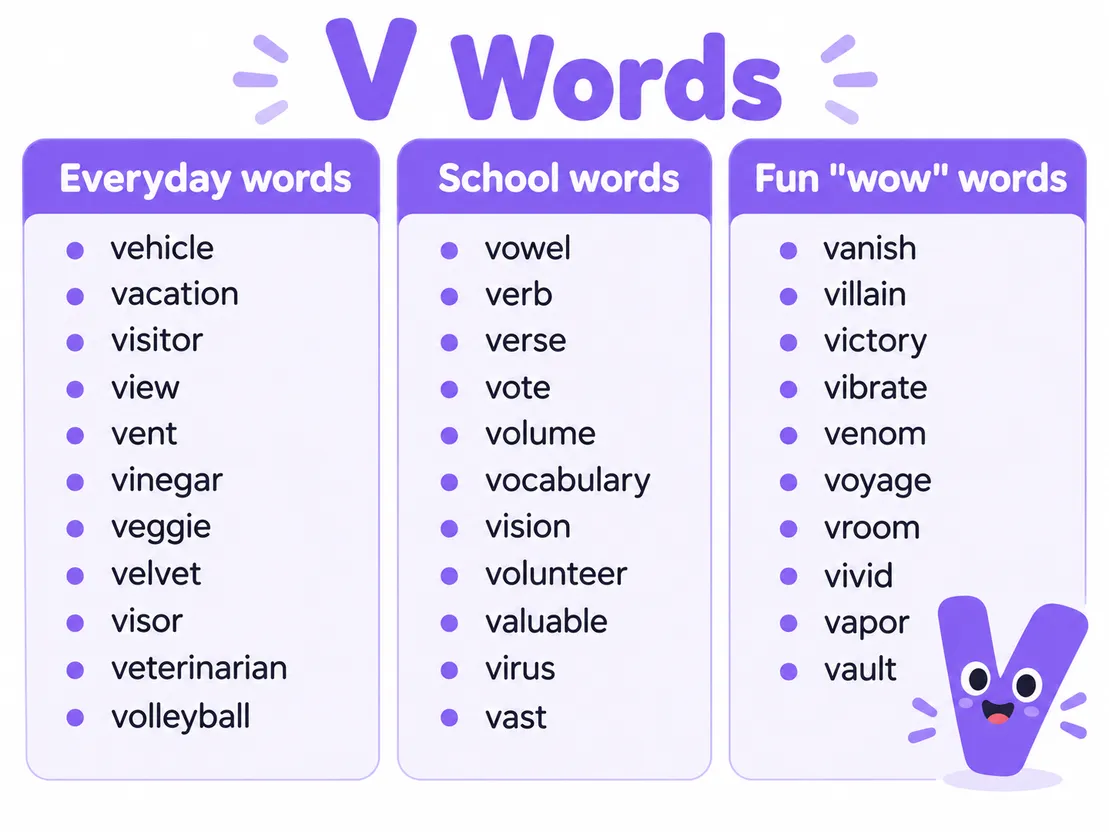
A few of these earn their spot. Vowel comes up in kindergarten reading lessons all the time, and kids think it's hilarious that the word for A, E, I, O, and U starts with a consonant. Verb and vote show up in class activities. Very from the preschool list is a common early sight word, so practice it until your child reads it without sounding it out.
For words with V for kindergarten, try "read it, say it, use it." Your child reads the word, says it with a big buzz, then invents a sentence. "The villain wore a velvet vest on vacation" scores three points. Expect the sentences to get weird fast. That's fine. Weird is memorable.
V at the End: The "-ve" Rule
English words almost never end in a bare V. There's nearly always a silent E after it: have, give, love, five, dive, cave, glove, brave. Kindergarteners spelling by sound will write "hav" and "luv," which is logical and also wrong. One way to explain it: V doesn't like standing at the end by itself, so E keeps it company. These words don't start with V, but they help your child notice the letter everywhere.
Things That Start With V for Preschool: A Room-by-Room Hunt
The easiest way to teach things that start with V for preschool is to go find them in your own house. Kids remember a thing they held way better than a thing on a worksheet. Grab a laundry basket, set a timer for ten minutes, and go room by room.
Kitchen: vegetables, vanilla extract, vinegar, vitamins, a vegetable peeler, maybe a vase on the table. The veggie drawer alone can get you four finds. (Whether anyone eats them afterward is a separate issue.)
Living room: the vacuum, a vent on the wall or floor, venetian blinds, a velvet pillow, and an old vinyl record if someone in the house still owns one.
Bedroom and closet: a vest, a sun visor, shoes with Velcro straps, and a toy violin if you've been brave enough to buy one.
Bathroom: the vanity, meaning the sink cabinet. Most kids have never heard that word, so it feels like a secret.
Outside: a vine on the fence, violets in the grass, the family van, and the little valve on the garden hose. A porch can double as a veranda if you say it with enough confidence. Out and about, keep an eye out for a vending machine.
Toy box: toy vans, a toy vet kit, a play volcano, and any stuffed vulture you happen to own. (You probably don't. But if you do, this is its big moment.)
For younger preschoolers, draw five tiny pictures on a sheet of paper and let them check each one off. Older ones can shout "V, vvv, van!" for every find. It's sound practice, and they won't notice.
V Words by Theme: Animals, Food, Vehicles, and Colors
Themed lists work because the V word gets attached to something your child already cares about. Start with whatever they're obsessed with this month.
Animals That Start With V
"What animal starts with V?" comes up every single letter V week. Luckily, the answers are pretty cool.
- Vulture. A big bird that soars in circles and cleans up nature. Kids love the gross parts.
- Viper. A snake with long fangs. Throw in "venom" while you're at it.
- Vole. A tiny, round rodent that looks like a mouse with a short tail.
- Vampire bat. A small bat from Central and South America. Yes, it's real.
- Vicuña. A fluffy cousin of the llama that lives high in the Andes.
- Vaquita. The world's smallest porpoise, found only in the Gulf of California.
- Vervet monkey. A small African monkey with a black face.
- Vizsla. A friendly reddish-gold dog breed from Hungary.
- Viceroy butterfly. Orange and black, and a near copycat of the monarch.
Foods That Start With V
You can eat these, which is the fastest way to remember a word. Try any vegetables, vanilla pudding, vermicelli noodles, a Valencia orange, a Vidalia onion (fun to say, less fun to bite into raw), venison if your family eats it, and vinaigrette on a salad. If your child is more into naming vegetables than eating them, Keiki's vegetable flashcards say each veggie out loud, which is a nice follow-up to a taste test that went half well.
Vehicles That Start With V
Car kids have more options than you'd expect: van, vehicle, a big sailing vessel, and a Viking ship with a dragon head on the front. Add vroom and you've got a race.
Colors and Feeling Words That Start With V
Violet is the obvious one. Kindergarteners, though, love fancy color names, so try vermilion (bright red-orange) and viridian (blue-green) and watch them use both at dinner. For pretend play, add vibrant (bright and bursting with energy), valiant (super brave), and victorious (you won!).
B, F, or V? When Mix-Ups Are Normal and When to Check In
Mixing up V with F or B is normal in young kids, especially before age 4. When your three-year-old points at a van and says "fan," their mouth just hasn't caught up with their brain yet. /F/ uses the same lip-and-teeth position as /v/, and /b/ is an earlier, easier sound, so kids borrow the one they've already got.
According to Crowe and McLeod's 2020 review, most children say /v/ correctly by around age 4. Related research by the same team found that typically developing 4- to 5-year-olds are usually understood even by strangers. So if your child is over 5 and still swaps out V most of the time, or you're uneasy about how clearly they talk in general, bring it up with your pediatrician or a speech-language pathologist. Asking early costs nothing, and most of the time you walk out reassured.
If your family speaks Spanish at home, expect "bery" to stick around a little longer. In Spanish, B and V usually sound the same, so your child is juggling two sound systems. That's normal. A mirror helps: teeth on the lip for V, lips pressed together for B.
A few small habits make a real difference:
- Repeat it back the right way. Your child says "Look, a fan!" You say "Yes, a big van!" with a little extra buzz. No correcting, no sighing.
- Use a mirror. Let them watch your teeth touch your lip, then copy you. Faces will be made. That's part of it.
- Feel the buzz. Hand on the throat, say "vvvv." It tickles. Switch to "ffff" and the tickle stops. Kids find this weirdly thrilling.
- Keep it light. Pressure makes kids clam up. Silly makes them want another turn.
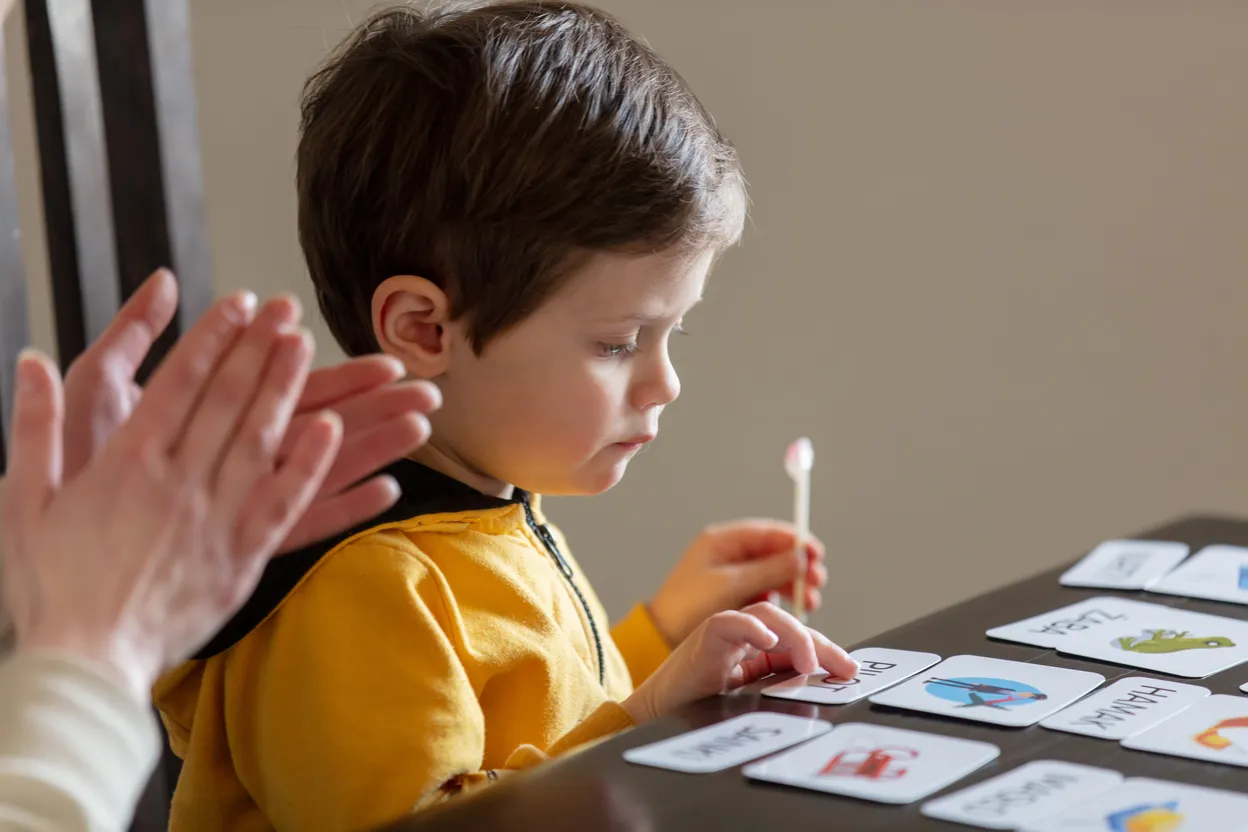
7 Letter V Activities for Preschool and Kindergarten
The activities that work best give kids something to hear, something to look at, and something to grab. All seven need about five minutes of setup, tops.
1. V Scavenger Hunt
Use the room-by-room list above and send your child hunting. Every find gets a big buzzy "VVVV-vase!" This is the fastest way to turn letter V words for preschool into things your kid can actually hold.
2. Vroom Vroom Car Race
Line up toy cars and vans and let your child "vroom" each one across the floor. They'll hold that /v/ for as long as they want, which is sound practice disguised as noise. Make a finish line out of painter's tape in a big V shape. Warn the downstairs neighbors.
3. Veggie Taste Test
Cut up three or four vegetables and let your child taste and name each one. Ask which one won. A vanilla yogurt dip on the side improves the odds considerably. If broccoli gets rejected, that still counts as saying "vegetable" out loud.
4. Body Letter V
Your child throws both arms up in a V and shouts a V word. Then two kids lie on the floor and make one giant V together. For kids who can't sit still (so, most kids), moving the whole body makes the letter shape stick.
5. Stuffed-Animal Vet Clinic
Set up a vet's office with a toy doctor kit and a line of stuffed animals. Your child is the vet. Listen for sentences like "This bunny needs a vitamin" and "Wait here for your visit." Pretend play gives new words a job, and kids take the job very seriously.
6. V or Not V?
Say a word. Thumbs up if it starts with V, thumbs down if it doesn't. Sneak in tricky pairs like van/fan, very/berry, and vest/best, and watch them squint. Hearing the difference comes before saying it, so this one matters more than it looks. Keiki's Hungry Frogs game practices the same skill, asking kids to hear a letter sound and pick the matching letter.
7. Violet Art Day
Hand over only violet crayons, paint, or paper and let your child make whatever they want. While they work, throw in V words: "Ooh, is that a violet volcano?" Kindergarteners can sign their masterpiece with a big V. It goes on the fridge. Obviously.
Build real skills through fun, educational games for your child
Try KeikiPlay and Learn More with Keiki
Once your child can hear the V sound and spot V things around the house, the next step is saying V words out loud without worrying about getting them wrong. Keiki's Talking Buddy lets kids answer a friendly character's questions in their own voice, which is easy speaking practice on the days you're out of scavenger hunt energy. Keiki World also has tracing games for uppercase and lowercase V, and its 1,500+ ad-free games and lessons for ages 2–6 adjust to each child's pace.