25 Cutting Activities for Preschoolers You Need to Try

If your young child picks up a pair of scissors, we can predict your first reaction. It's probably fear, panic, a spike of adrenaline and blood pressure. And that reaction is understandable: from the moment a baby appears in the house, we know to hide away all sharp objects, put locks on the cabinet doors, and generally watch every second to make sure nothing sharper than the jokes in the cartoons they watch ends up within the growing little one's reach. But can such overprotection be justified?
Key Takeaways
- Learning to cut builds fine motor skills, hand strength, hand-eye coordination, and the bilateral coordination that later supports handwriting.
- The right tool matters most: use spring-loaded safety scissors with rounded tips and metal blades for paper.
- Progress through four stages: snipping, straight lines, curves and shapes, then advanced challenges.
- Keep sessions short and frequent, praise the effort rather than the result, and never leave a child alone with scissors.
Cutting Activities for Preschoolers
After all, from a certain point on, using those same scissors is the mastering of an important skill tied to children's cognitive and physical development. Does that mean you should hand your child scissors and come what may? Of course not. Your job as a parent is to create a safe, controlled, and engaging environment for practice. Quality cutting activities for preschoolers not only develop the hands but also give a child a sense of independence: "I can change the shape of objects myself!". In this article, we'll take a detailed look at why this skill is so important, how to choose the right tool, and, most importantly, share a collection of 25 ideas.
Why Cutting Activities Matter for Preschoolers
Cutting with scissors seems like an elementary action to us adults. But for a child's brain it's far from it. You need to synchronize many of the body's systems and areas of the brain to handle this kind of gymnastics within the fingers. Let's look at what ordinary cutting practice actually trains:
- Development of fine motor skills. Working with scissors requires isolating finger movements. The child has to use the thumb, index, and middle fingers independently of the rest. And, by the way, in the future this will help them master writing with a correct pencil or pen grip faster and more easily.
- Hand strength. Opening and closing stiff blades is a full workout for the tiny muscles of the palm. Without this strength, a child will tire quickly when writing at school.
- Hand-eye coordination. To cut paper along a line, the eyes have to continuously track the path and send the brain signals about exactly how to turn the hand.
- Bilateral coordination. This is the ability to use both sides of the body at once, but for different tasks. One hand holds and turns the paper, while the other, dominant one, squeezes the scissors. This is a leap in fine motor development.
By regularly offering your child engaging preschool cutting activities, you're not just keeping them busy for half an hour but building the foundation for their future school performance and everyday independence.
Help your child
grow with Keiki
We’ll help you turn everyday screen time
into real learning progress.
Stage 1: Snipping Practice (First Cuts)
The first stage is snipping. The child doesn't need to move the scissors forward yet. The whole task is to make one single snip to cut off a piece of material. At this stage we're forming the correct grip.
Playdough Snips
Roll long thin sausages out of soft modeling clay or salt dough. Give your child fully plastic safety scissors. Let them cut the dough into small pieces. The dough is dense, holds well in one hand, and cuts effortlessly.
Straw Snipping
Take colorful plastic drinking straws. Cutting them is an incredibly fun preschool cutting activity, because the cut-off pieces fly off in different directions with a funny sound! Later these pieces can be used as beads to string onto a cord.
Grass Cutting
Go outside or gather a bunch of long grass and dandelions in a container. Let your child freely trim the grass right in the garden or on the balcony.
Toilet Roll Haircuts
Take a cardboard toilet paper tube and draw a funny face on it. Make a fringe along the top edge with scissors; this will be the hair. The little one's task is to trim the cardboard strips with a single snip of the blades, giving the little character a short haircut.
Yarn Snipping
Give your child a skein of thick acrylic yarn. Show them how to cut small pieces off it. The cut yarn can then be glued onto paper, creating a fluffy cloud or a sheep.
Snipping Sensory Bin
Gather various safe materials: pieces of foam sponge, boiled spaghetti, lettuce leaves. Put them in a large bowl and let your child chop them into small pieces with scissors. It's a great way to combine a sensory bin and motor-skills practice.
Paper Strips
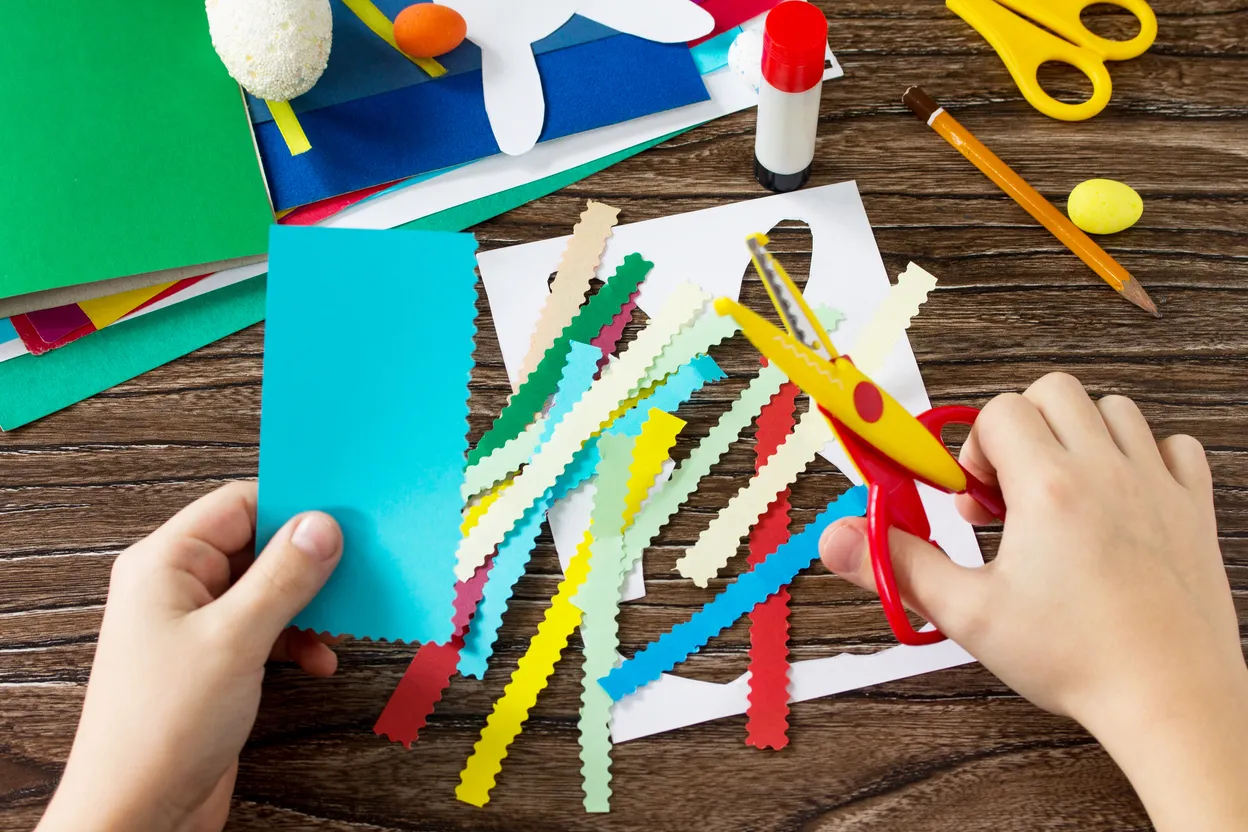
Cut thick paper (around 160 g/m²) into narrow strips about 1.5–2 cm wide. The child should snip little squares off the strip with a single cut. These squares can later be made into a mosaic collage.
Stage 2: Cutting Straight Lines
As soon as preschool scissor skills have strengthened and the child has understood the "open-close" mechanics, it's time to move on to going forward. At this stage the child learns not just to close the blades but also to push the hand along the sheet. Here we practice making straight lines.
Road Cutting
Draw a thick black straight line on a rectangular sheet of paper. Stick a car sticker at the end of the line and a garage at the start. Tell your child: "Your scissors are a car, and it has to drive exactly along the road to the garage!".
Sticker Lines
If it's hard for your child to follow a drawn line, stick a row of several bright round stickers. The little one's task is to cut the paper so as to slice each sticker in half. Visual markers really help hold attention.
Fringe and Confetti
Take a paper plate and ask your child to make cuts all around its edge, moving 3–4 centimeters inward. You'll get a fluffy sun or a lion's mane. This is a great cutting activity for preschool for practicing the long stroke of the scissors.
Wrapping Paper Practice
Many kinds of wrapping paper have a grid with perfect straight lines printed on the back. This paper is thin, cuts very easily, and gives the child clear guides for practice.
Sticky Note Fence
Stick a row of office sticky notes right at the edge of the table so that half of them hang down. The child should come up to the table and cut the hanging edges from the bottom up. This helps keep the scissors in the correct vertical position.
Washi Tape Cuts
Stick strips of colored decorative tape onto thick cardboard a short distance apart. Ask your child to cut the cardboard exactly along the tape strips. The tape creates slight resistance and keeps the blades from slipping.
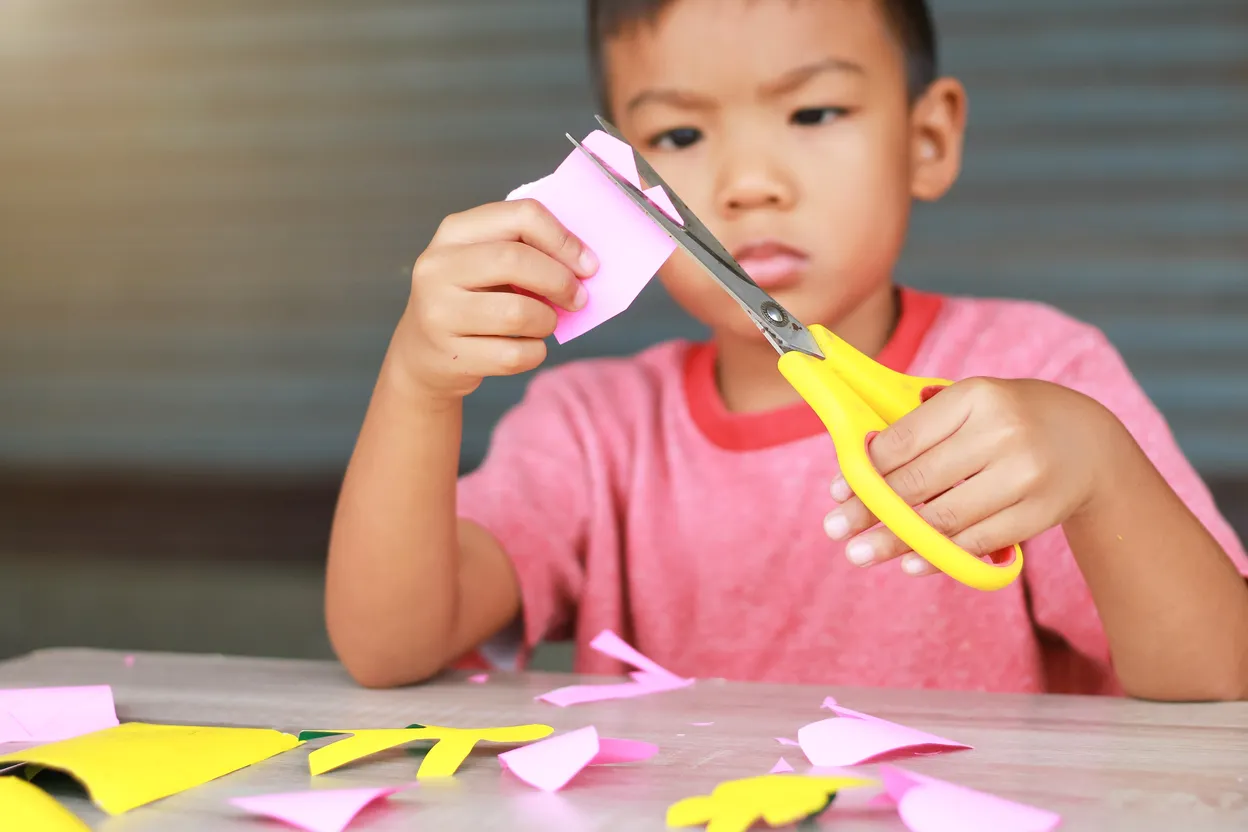
Stage 3: Cutting Curved Lines and Shapes
The third stage requires active involvement of the second hand. Now the paper needs not just to be held but smoothly turned toward the blades. These are the most effective cutting activities for preschoolers for training bilateral coordination.
Wavy Ocean Lines
Draw thick, smooth waves on blue paper. At the end of each wave draw a boat. The child will have to smoothly change the direction of their hand so the scissors don't stray off course.
Paper Plate Spiral Snake
Draw a spiral from the edge to the center on a cheap paper plate. Draw a snake's head in the center. The child starts cutting from the edge along the line and, constantly turning the plate, reaches the center. When they finish, they'll have a cool springy snake toy in their hands!
Circle Rescue
A circle is the first full shape children master. Draw a large circle and stick a sticker of a bear or any favorite character in the center. The child's task is to cut out the circle along the outline to rescue the hero from the trap.
Shape Collage
Draw large, clear squares, rectangles, and triangles on colored paper. Ask your child to cut them all out. Then give them a glue stick and a blank sheet so they can build a house, a robot, or a rocket out of these shapes.
Cloud Cutting
Draw clouds made up of many semicircles. Cutting along such a line is hard, since you constantly have to turn the paper and stop the blades. It's a great trainer for smooth movements.
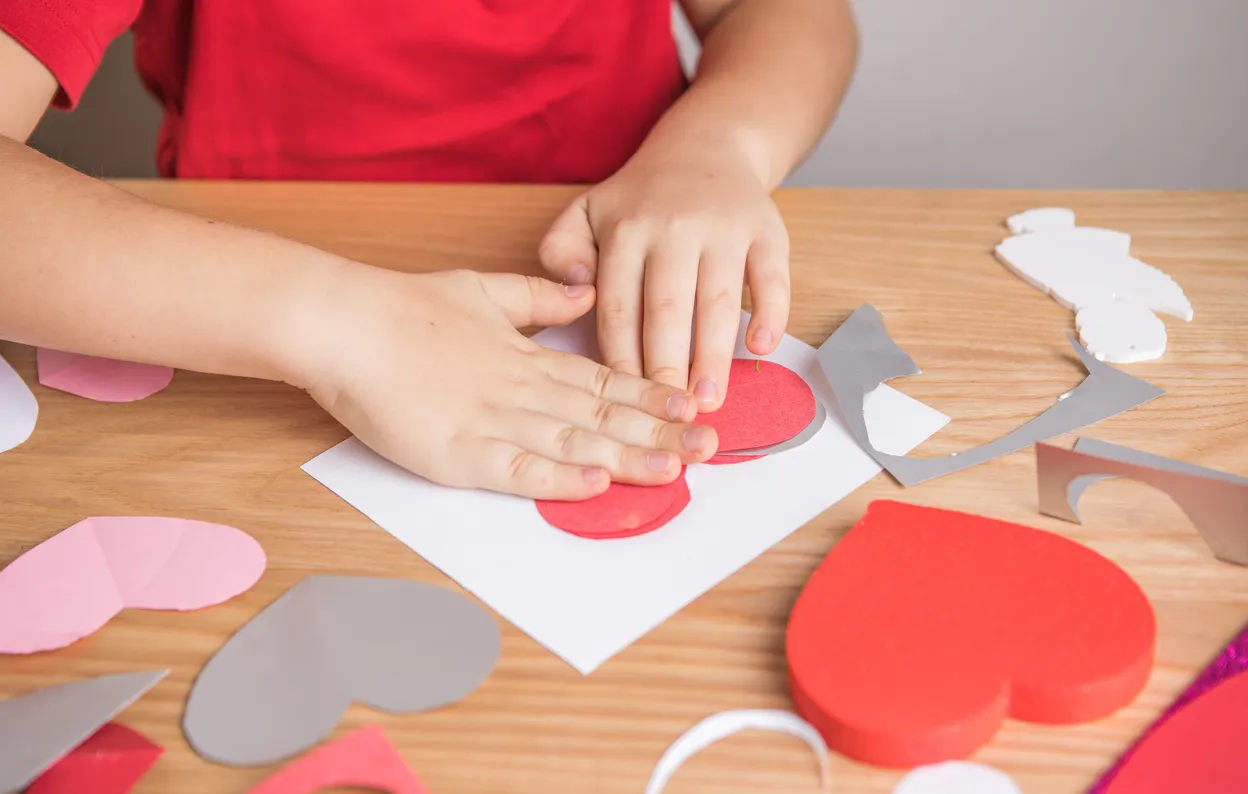
Folded Hearts
Fold a sheet of paper in half. Draw half a heart from the fold. Let the child cut out the shape along the line. Unfolding the sheet and turning a piece of paper into a symmetrical heart always delights preschoolers.
Stage 4: Advanced Cutting Challenges
Once the basic skills are mastered, it's time to offer complex, multi-part tasks. Here safe cutting activities for preschoolers combine with creativity, texture experiments, and high concentration.
Complex Outlines
Suggest your child cut out a star or a zigzag. Here you need to be able to stop the blades at a corner in time, turn the paper 180 degrees, and start cutting in a different direction.
Cardboard Construction
Save cereal or delivery boxes. Cardboard is much harder to cut than paper. This is now a full workout for hand strength. Let your child cut the cardboard into strips or squares to create 3D crafts.
Magazine Scavenger Hunt
Give your child a stack of old glossy magazines or supermarket advertising catalogs. Give a task: "Find and cut out 5 red objects, 3 cars, and something sweet." The child will have to maneuver the scissors carefully around the complex outlines of real objects.
Felt and Fabric
Cutting fabric requires very good, sharp scissors, always under strict adult supervision. The feel of cutting soft felt is radically different from paper. This broadens the tactile experience and requires a confident grip.
Nature Leaf Cuts
Gather large autumn leaves on a walk. Ask your child to cut shapes out of them or simply snip a fringe along the edges. Dry leaves crunch funnily, while fresh ones cut almost like rubber.
Snowflake Making
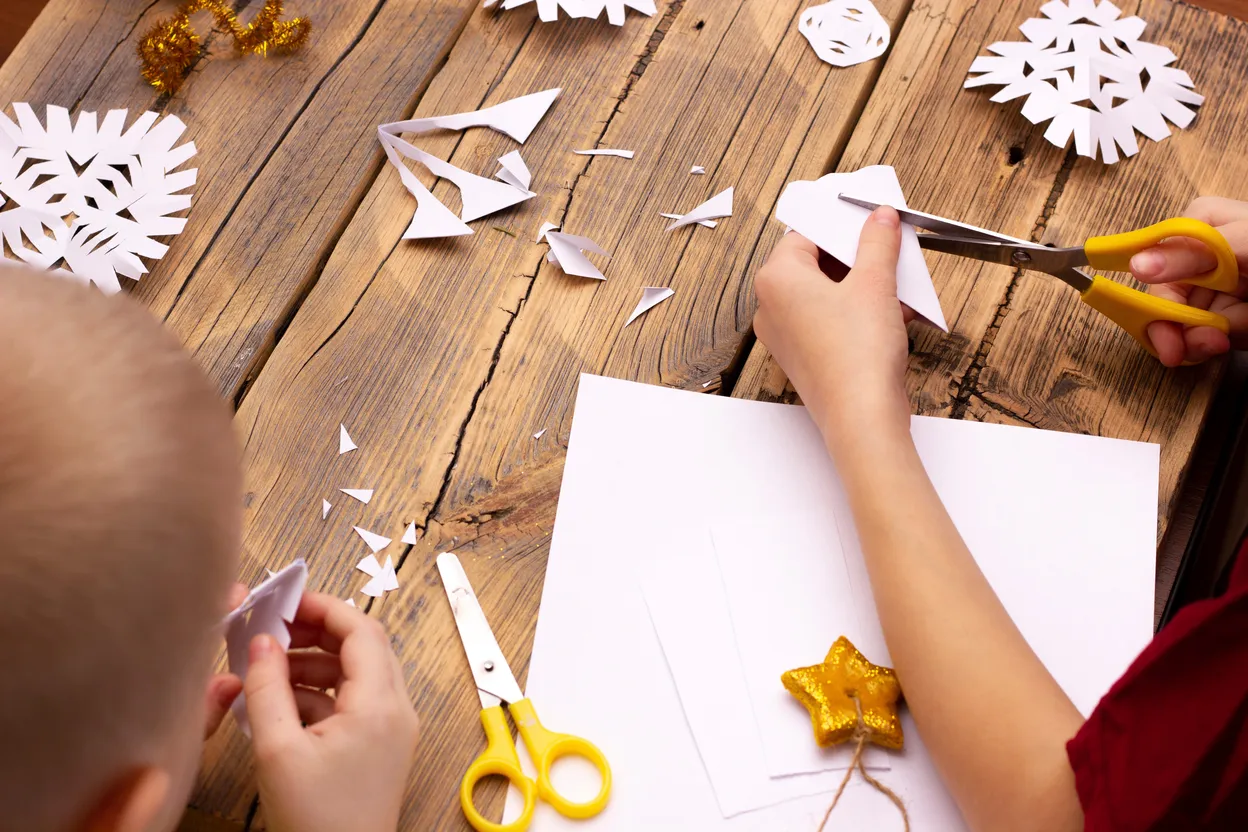
A classic that never gets old. Fold thin paper (for example, tracing paper or coffee filters) several times. The child needs to make small cuts (triangles, circles) along the edges of the folded triangle. This involves both spatial thinking and the display of finger strength.
Choosing the Right Scissors for Preschoolers
The success of any cutting activity for preschoolers depends 90% on the right tool. You can't give a child huge kitchen scissors or manicure clippers. For the process to be safe, you'll need quality kids' safety scissors.
What to look for when choosing:
- Blunt tips. The blades should be rounded so the child can't prick themselves.
- Blade material. Fully plastic scissors are only good for working with modeling dough. For paper they often turn out too dull, chew up the sheet, and cause frustration in the child. Choose metal blades with blunt tips.
- Spring mechanism. On the handle of such scissors there's a small plastic spring. It automatically opens the blades after each squeeze. The child only needs to squeeze the handle.
- Hole size. One hole should be small, for the thumb, and the other elongated, for the index and middle fingers.
The golden rule: "Thumb points to the sky!". Draw a small smiley face on the nail of your child's thumb with a marker. Explain: when they cut, the smiley should always face up, straight at them.
Build Fine Motor Skills Through Play With Keiki
Today there are more debates than ever about what's better: familiar paper games or online entertainment? But we believe the secret to harmonious development lies in a wise balance. A child needs to develop both the body and motor skills and the brain's cognitive abilities.
You can train the brain not only with scissors. Keiki fits here too. To train logic, memory, basic math skills, and thinking speed, we created a safe, interactive mobile app. There your child can do puzzles, go through mazes, and play developmental brain development games.
What's more, Keiki has plenty of printable materials waiting for you. With them you'll always have ready-made tasks for engaging leisure time, including ones you can combine with scissors, killing two birds with one stone. Keiki helps you ensure all-around development: cognitive interactive games in the app, and PDF materials on paper for developing cutting practice and fine motor skills in real life.
Help your child thrive with playful learning
Turn screen time into real growth with Keiki's educational games.
Try KeikiConclusion
Learning to work with scissors isn't a simple one-day task. It's a whole journey that will include crookedly cut corners, torn paper, and maybe a few minutes of parental panic. But every time the blades close, your child's nervous system becomes a little more refined.
Start with simple steps. Turn cutting straws or trimming dough into a fun game. Use our cutting activities for preschoolers as a source of inspiration. Praise your little one for the process, not for a perfect result, help them hold their hand correctly, and remember: patience and practice work real wonders.