Singing games for kids – rhythmic and engaging ideas for children

Singing games turn music into active learning. Through simple songs and playful prompts, kids practice language, memory, rhythm, and confidence—great for circle time, car rides, or at-home fun.
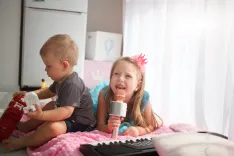
Singing games for kids that support language and memory
A song is more than just a set of sounds, it is a language that every child understands. From the earliest age, children intuitively respond to melodies, rhythm and intonation. Singing games for kids both entertain and open up an entirely new world of sounds and songs, yet even behind simple melodies there is enormous potential for developing speech, memory and emotional intelligence. They help children explore the world through sounds and movement.
In our fast world, where there is less and less room for spontaneity, music helps children relax, express their feelings and strengthen their bond with parents. The purpose of this article is to show you how to make singing a natural and joyful part of your child’s life, not a boring activity. Get ready to sing, dance and have fun together!
Why you should definitely include singing games in your routine
Singing is a unique activity that simultaneously trains several key skills necessary for full development. Kids singing games work in several directions:
- Development of speech and language skills. Singing trains articulation, rhythm and intonation, helping the child pronounce words and sounds correctly. Children learn not only to speak, but to do it beautifully and expressively.
- Training memory and concentration. Memorizing song lyrics and melodies is excellent memory training. A child learns to focus on the words and music in order to reproduce them later, which directly affects their ability to learn.
- Emotional development. Music helps children express feelings. With the help of songs, they can show joy, sadness, surprise and other emotions. This increases empathy and the ability to understand the mood of other people.
- Development of social skills. Group singing teaches taking initiative, waiting for one's turn and working as a team. Music games for kids form skills that will be useful in kindergarten and school.
- Improvement of motor skills. Action songs perfectly develop gross and fine motor skills, coordination and a sense of rhythm. The combination of music and movement helps the child better understand their body in space.
Singing games are a key to developing creativity
You can use educational songs for kids or play cool, interesting games that in one way or another involve rhythm, music and creativity. We have collected ideas for various activities.
Help your child
grow with Keiki
We’ll help you turn everyday screen time
into real learning progress.
Games for speech and memory development
Songs are not only a way to express yourself. Thanks to the right presentation, rhyme and rhythm, they help children better absorb information, remember new words and concepts. There are even special speech development through songs.
Sing the next line
Start singing a familiar song, and the child must continue the next line. This is a great way to check how well they remember the lyrics and make the process engaging.
Guess the melody
Hum or sing “la-la-la” to a familiar melody, and the child must guess which song it is. Then switch roles.
Song backwards
This is a challenging but very fun game. Try singing a song from the end to the beginning – it is great for training logic and memory.
Complete the word
Sing a song and skip some words, and the child must complete them. For example: “We are not afraid of the gray...” (“wolf!”).
Song alphabet
Find or invent words for each letter of the alphabet and sing them using any familiar melody. This helps learn letters and expand vocabulary, and such music games for shy kids suit even the most timid children.
Games with movements and dancing
Movement is a good way to increase activity, develop discipline and even memorize new information. It is no coincidence people say movement is life. Fine motor skills activities with songs are perfect here, and we prepared ideas for you.
Head, shoulders, knees and toes
This classic song with movements trains coordination and helps the child learn body parts.
If you're happy and you know it
Sing the song and perform the movements. Take turns inventing new actions such as: “If you're happy and you know it, do this… draw a star!”.
Freeze!
Sing a fun song and dance, and when the music stops, you must freeze in a funny pose. Whoever moves is out.
Repeat the movement
Sing a simple phrase and show a movement. The child must repeat your movement and add their own. You can create a long chain of movements.
Song-dance
Turn on rhythmic music and improvise dance moves for the child to repeat. This is fun and also great for coordination.

Games for creativity and improvisation
Creative music games for children help reveal creativity and imagination at any age. What adults see as simple fun or silliness can actually be the beginning of something bigger.
Musical story
Create a simple story and sing it, adding new characters or events. You can use these songs for kindergarteners for groups of children or play at home.
Sing your feelings
Ask the child to sing about what they feel to express their emotions. For example: “I am so sad, I really want to...” This helps them recognize and express their feelings.
Song from objects
Choose several objects in the room (a ball, a chair, a book) and invent a song about them. This trains imagination.
Change the song
Take a familiar melody and invent new words for it. For example, sing “Antoshka” about a cat who loves to play.
Question–answer
You sing a question, and the child must sing an answer. For example: “Where is the sun today?” – “The sun is high!”
Build real skills through fun, educational games for your child
Try KeikiHow to help a child during the game: 6 tips for parents
All these singing games for speech delay, rhythm tasks or vocabulary growth will work even better if you follow certain tips:
- Sing together. It doesn’t matter what your voice sounds like. What matters is your desire and participation. Children learn by imitating adults, and your example is the best motivation.
- Do not criticize. Do not correct or criticize the child, even if they sing off-key or mix up the words. Praise for effort is much more important.
- Create a music corner. Designate a place to keep musical toys and instruments: rattles, toy drums or a synthesizer.
- Use props. Hats, scarves and toy microphones make the game more exciting and inspiring.
- Make music part of the routine. Sing while brushing teeth, in the bath or while cooking. This makes singing a natural part of the day.
- Let the child choose. Allow the child to choose which song or game you will sing. This gives a sense of control and independence.
Related Games in Keiki App




Can apps help with creative development?
The Keiki app can be an excellent addition to physical play. Yes, it may include songs for confidence building and musical tasks, but the games can also be used for breaks. In Keiki every task and even the menu is accompanied by musical themes. But you will also find other interesting games that develop the same skills that singing develops:
- Creative corner. Children who love to sing often show interest in other creative activities. Games that teach drawing, crafting and self-expression reveal a child's full creative potential. Keiki includes several tasks in one where children can express themselves.
- Coloring. Just like the creative corner, here kids can express themselves by coloring ready-made pictures or drawing on a blank canvas.
- Candy words. Word games expand vocabulary and create strong associations, just like songs with words and rhyme help develop vocabulary in a playful way.
Songs for toddlers and preschoolers, singing games and rhythm games give a boost to creativity, help explore the world and entertain at the same time. Turn every song into a fun and useful ritual, and the Keiki app will help you with this.