Mexican Revolution Day Activities for Kids: Ideas for Preschool and Elementary School

Every November 20, schools across Mexico fill up with paper mustaches, tricolor sashes, and tiny soldaderas in long skirts and rebozos. If you're looking for Mexican Revolution Day activities to prepare for that date with your child or your group, this guide can help. It gathers ideas organized by age, from preschool through elementary school. In 2026, the official day off falls on Monday, November 16.
But the historical date is still November 20, and most school events are held around that day. Here you'll find activities for Mexican Revolution Day built for the classroom, plus options to put together at home the weekend before. We've also included Mexican Revolution activities for kids that don't need complicated materials or hours of prep.
Key Takeaways
- Mexican Revolution Day activities work best when they match the child's age, not one single level for everyone.
- November 20 is still the symbolic date for school events, even though the official day off in 2026 falls on Monday the 16th.
- Popular crafts like the hat, the mustache, and the tricolor sash also help build fine motor skills while kids get ready for the parade.
- You don't need a big budget: most of these ideas use paper, cardboard, and materials you already have at home.
What Is Mexican Revolution Day?
Mexican Revolution Day marks November 20, 1910. That day, Francisco I. Madero called for an armed uprising against the government of Porfirio Díaz through the Plan de San Luis.
The call started several years of fighting, with figures like Francisco Villa, Emiliano Zapata, and Venustiano Carranza at the front. Each one had his own demands about land, labor, and how the country should be run. The movement lasted through the decade and ended up shaping the Constitution of 1917, which is still in effect today.
You don't need to go into the details of the armed conflict to explain this to a young child. It's enough to say that, more than a hundred years ago, a group of Mexicans decided to fight for a fairer country. That's why schools hold parades and events every November 20 to remember them. That short version works well as a starting point before moving on to the activities below.

Help your child
grow with Keiki
We’ll help you turn everyday screen time
into real learning progress.
Mexican Revolution Activities for Preschool
Mexican Revolution activities for preschoolers work best when they're short, highly visual, and don't depend on the child understanding dates or full names. At this age, what sticks is the image and the feeling of having taken part, not the historical fact.
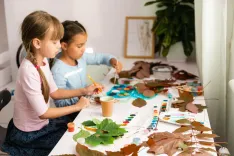
- Color simple characters — Print large outlines of a soldier or a soldadera and let the kids color them in with the colors of the flag.
- Make a paper hat — Fold a sheet of brown cardstock into a wide-brimmed hat. It's the most common preschool craft for a reason: it comes together fast and looks great in the event photos.
- A paper mustache for pretend play — Cut out a big mustache, glue it to a craft stick, and let the kids "dress up" for a while without putting together a full costume.
- A tricolor sash — Join strips of green, white, and red paper to cross over the chest, just like the ones adults wear in the real parades.
- Watch a short video and dance — Find a one-minute animated video about November 20 and close the activity with a song or a simple circle dance.
Mexican Revolution Activities for Elementary School
In elementary school, Mexican Revolution activities can already include research, reading, and a bit more independence, without losing the creative side that makes the day memorable.
- An illustrated timeline — Have each child research one event or figure and draw it on a card; at the end, line the cards up on a string across the room.
- A historical figures memory game — Make matching pairs of cards with the faces of Madero, Villa, Zapata, and Carranza, and turn it into a classic memory game.
- A Revolution newscast — In teams, have kids prepare a short news segment as if they were reporters in 1910, using what they researched in class.
- A group mural — As a whole class, paint a large mural with scenes from the movement: the railroad, the countryside, the soldaderas.
- Word search and crossword — Using the names of key figures and dates; it's a simple way to review without it feeling like a test.
Mexican Revolution Activities for First Grade
First grade sits right between preschool and the rest of elementary school: kids can already read a little, but they still tire quickly of anything too abstract. For this group, mix something from preschool with something a bit more structured.
- Guided drawing with a short phrase — Have kids copy and decorate a short phrase like "Viva la Revolución" next to a drawing of their favorite figure.
- Sort objects from the period — With cards showing objects like a train, a horse, a hat, or a sewing machine, have kids sort them into "things we use today" and "things from that time."
- Act out a small parade — With homemade drums made from cans or boxes and the flags or hats they already made, organize a mini parade through the classroom or the yard.
Crafts and Costumes for the Parade
If your school is organizing a parade or a civic ceremony, these are the crafts that come up year after year. They're usually also the activities teachers ask for the furthest in advance.
- The cardboard cartridge belt. Cut strips of cardboard or a flattened toilet paper roll. Paint small cylinders to look like prop bullets, and glue them in a row along a strip that crosses the chest.
- The soldadera skirt or rebozo. A large square of fabric folded diagonally works as a rebozo; for the skirt, a piece of fabric tied at the waist with a ribbon is enough.
- The wide-brimmed hat. The cardstock version works for preschool, but in elementary school you can use a large paper plate covered in brown fabric so it lasts for more than one use.
- The painted mustache and eyebrows. With a dark eyeliner pencil or lip liner, draw a big mustache and bushy eyebrows. It's the detail kids like most, because they get to check themselves out in the mirror before heading out.
Most of these crafts call for cutting shapes with scissors. If your child isn't quite comfortable with cutting yet, these cutting activities for preschoolers give you some practice exercises before the big day.
And if you want the craft to come together well instead of just being glued any which way, these fine motor activities help too. They get hands ready to fold, roll, and glue with more control.
Games and Activities for the Classroom or Home
Not every Mexican Revolution activity has to involve crafts. These games work well for wrapping up the themed week, or for filling the last fifteen minutes before parents arrive for the event.
- Guess the figure — Give clues one at a time, like "he wore a hat" or "he fought for land in the south." Kids raise their hands when they think they know who you're talking about.
- Revolution obstacle course — Set up a simple path with obstacles (hoops, cushions as "rocks," a rope as a "river") and time who crosses it the fastest.
- Classroom kermés — Set up pretend food stalls and let kids "buy" with paper tokens, just like the real kermeses held on November 20.
- Revolution-themed I Spy — Stick pictures from the period around the room and play "I spy," asking kids to find the train, the horse, the hat, or the flag.
After the Parade: Keep Going with Keiki World
After the parade, the creative energy doesn't have to stop. Plenty of kids who enjoyed painting a hat or putting together a cartridge belt are still in the mood to keep drawing and creating. That's where Keiki World's drawing games section is a good quiet option for the rest of the day.
In Keiki World, the drawing games let kids pick colors, trace shapes, and complete scenes at their own pace. No adult has to walk them through every step.
This doesn't replace the craft work they did at school. But it works well as that calm screen moment after a morning full of physical activity and a lot of stimulation. If your child already showed interest in the colors of the flag or in painting hats, this can be a good bridge. It lets them keep going with something creative, without pulling out more paper and glue.