How to teach kids to draw – tips, exercises, benefits

Child development is a complex and multifaceted process. The first things that usually come to mind are difficult attempts to master numbers, writing, and reading. After all, these are the skills children will need at school. Many parents think of them as essential, and overall this view is correct. But one small yet very important detail is often overlooked – creative development and drawing skills.
They are no less important than academic preparation. In fact, they can even make learning easier by making the brain more flexible and forming new neural connections.
When we hear the phrase how to teach kids to draw, we often imagine a strict teacher and boring still lifes. But for a child from 1 to 6 years old, learning is not an academic skill. It is an expansion of imagination, creativity, and ways of exploring the world. In some ways, drawing is also a method of expressing thoughts and emotions – simply through images and lines.
The best teacher for a preschooler is their own curiosity. Our task is not to force a child to draw “correctly,” but to show how exciting it can be. Learning to draw for beginners can be introduced gently, playfully, and with enjoyment – which is exactly what we will discuss next.
First steps – creating the right space for creativity
All children, even the youngest ones, are a fiery mix of curiosity and a spirit of experimentation. But not all of them carry this curiosity into adulthood, and not all of them direct it in the right way.
Learning to draw cannot happen in a single day. It is not a final result but an ongoing process that begins with the basics and keeps improving over time.
Before moving on to art lessons for kids at home, it is important to prepare the ground – both physically and emotionally. A child cannot create if they are afraid of ruining the carpet or hearing criticism. The following tips can help.
- Accessibility of materials. Keep paper and crayons within reach. This encourages spontaneous creativity. You can create a small drawing corner with a table and chair where all the tools are gathered.
- No criticism. For children under six, there are no wrong colors or imperfect results. If you are looking for creative drawing tips for parents, the most important one is simple – praise effort and courage rather than similarity to reality.
- Comfort zone. Use materials that are easy to clean so your “no, don’t make a mess!” does not interrupt your child’s inspiration.
- Practice different approaches. Creativity thrives on experimentation, so learning creativity should also be flexible. Use different materials, go on outdoor sketching picnics, and try drawing apps with tasks.
And most importantly – support any interest in drawing. Young children need encouragement, and the strongest motivation in preschool years is the presence of parents and loved ones nearby.
Teaching methods for different ages
Learning should follow brain development. We cannot expect even simple drawing for preschoolers from a two-year-old who still struggles to hold a pencil.
Toddlers (1–3 years) – exploring tools
At the stage of teaching drawing to toddlers, the focus is not on drawing objects but on learning to use tools.
A gradual and gentle introduction to drawing is the best way to spark a child’s interest in creativity. Here are a few ideas.
- Draw next to your child. Simply make lines, circles, and dots. Toddlers love imitation and will begin repeating your movements.
- Choose very simple shapes and subjects. If the drawing is too complicated, the child will not be able to follow.
- Use large sheets on the floor. This allows children to engage their large motor skills before moving to precise hand movements.
- Do not criticize or try to correct scribbles. They are a natural stage of learning to draw.
Preschoolers (4–6 years) – building the world
At this stage you can start using drawing tutorials for kids, but in a playful way. The key principle is that drawing must remain enjoyable, not an obligation or a boring lesson.
You can use the geometric construction method. It shows how objects consist of simple shapes. For example, a cat can be built from circles and triangles for ears, nose, eyes, and paws.
This is the foundation of learning to draw for beginners – the ability to see simple forms inside complex objects.
Another useful approach is completing drawings. Draw half of a picture and invite the child to finish it. This removes the fear of a blank page while encouraging imagination and independent thinking.
Help your child
grow with Keiki
We’ll help you turn everyday screen time
into real learning progress.
Why teach a child to draw?
Many parents see drawing simply as a way to keep a child busy for half an hour while they drink coffee. But in reality, when you look for ways how to teach kids to draw, you are investing in their intellectual foundation.
Here are several reasons why creative development matters.
- Development of fine motor skills and preparation for writing. Every line trains the small muscles of the hand and fingers. The more confidently a child holds a pencil, the easier it will be to learn writing at school.
- Stimulation of neural connections. Creative activity engages both hemispheres of the brain – the right hemisphere responsible for creativity and imagery, and the left responsible for logic and planning.
- Cognitive development. Drawing teaches children to analyze shapes and space. A child learns that an object can be divided into parts – a circle, triangle, or square – which forms a foundation for mathematical thinking.
- Emotional intelligence. Drawing is a safe way to express feelings that are difficult to describe with words. It reduces stress and helps children understand themselves better.
- Concentration and patience. To finish a drawing, a child needs to maintain attention. This becomes a simple yet effective training of persistence, something many modern children lack in the era of fast content.
At Keiki World, we believe the importance of drawing in child development cannot be overstated. That is why our app is designed to gently support these skills and turn learning into enjoyment.
How apps can help a child learn to draw
Many parents search for step by step drawing for kids online, and this can be a great tool when used correctly.
Interactive tasks or digital canvases with many colors, pencils, and markers allow children to learn easily, while parents do not worry about preparation or mess at home. A smartphone or tablet is always nearby, and starting an activity takes only a few taps.
Here are a few helpful activities.
- Free creativity in Keiki World. A digital canvas with many tools and the ability to erase mistakes instantly. Drawing in the app can easily capture a child’s interest.
- Completing drawings by pattern. Connecting dots or tracing geometric shapes helps develop muscle memory while providing a simple but creative task. Children also remember shapes and their names.
- Coloring. Starting from a blank page can be difficult. Coloring gives imagination a starting point while still leaving room for creativity through colors and choices.
In Keiki World there are not only digital coloring activities but also printable sheets, which fit perfectly into traditional creative routines. Educational drawing apps for children do more than show pictures – they guide children step by step, helping them trace lines and see how simple strokes become a character.
This may be the best answer to how to teach kids to draw – when learning feels like a cartoon created by the child.
Help your child thrive with playful learning
Turn screen time into real growth with Keiki's educational games.
Try KeikiExercises and games that teach drawing
To prevent art lessons for kids at home from becoming a boring obligation, use a playful approach. Creative tasks and drawing games keep children interested while helping them develop skills.
Blind drawing
Try drawing something simple with your eyes closed, then laugh together at the result. After opening your eyes, turn the scribbles into something recognizable. This helps children overcome fear of mistakes and develop imagination.
The traveling line
Draw one continuous line across the entire sheet. Then look for hidden animals in the shapes and color them. It resembles the previous exercise but focuses more on patterns.
Artist’s dictation
Describe an object or scene – for example, “draw a big circle, and inside it two small circles.” The child draws what they hear. This is a great exercise for listening skills and simple drawing for preschoolers.
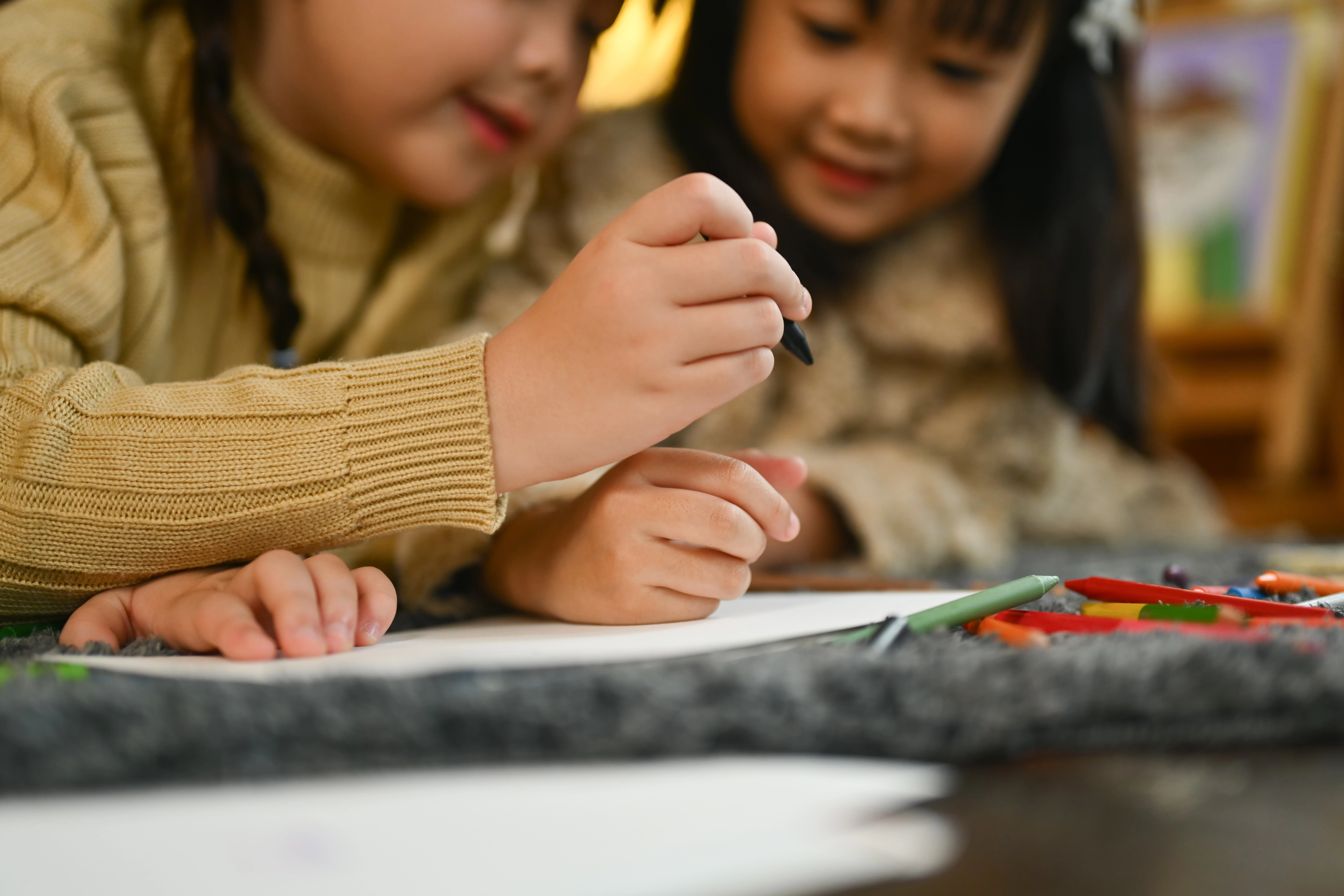
Shadow theater
Place a toy such as a dinosaur or giraffe under a lamp so its shadow falls on paper. Ask the child to trace the shadow outline. It is a simple way how to teach kids to draw complex shapes by following light.
Stencil magic
Use leaves, coins, or hands as templates. Trace them and imagine they represent something else. This is an easy method of learning to draw for beginners and encourages creative thinking.
A story on paper
Children love stories and characters. Start drawing a character and tell a story about them. Let the child add elements to the picture – a hat, umbrella, or puddle. This combines storytelling and drawing.
Cloud painting
Drop paint on one half of a sheet, fold it, and smooth it out. After opening it, discuss what the shape looks like. This activity develops associative thinking.
You can also introduce symmetry. For example, draw half of a butterfly on folded paper, cut it out, and unfold it to create a symmetrical shape. The same technique works for painting the wings.